
A foodservice GPO (group purchasing organization) aggregates many buyers to access pre-negotiated manufacturer and distributor programs, and is typically funded by administrative fees paid by manufacturers. An outsourced procurement team negotiates your own distributor agreement directly on your behalf and is typically paid by you, often based on savings delivered. The practical difference is whose interests the fee structure aligns with.
Why this comparison exists at all
An independent operator who concludes that their distributor pricing is not competitive has, broadly, three options: negotiate alone, join a GPO, or engage a procurement team. The first rarely works, not because operators lack skill but because they lack the one thing the negotiation depends on: knowledge of what the distributor's actual cost and margin are on the items they buy. Negotiating without that is guessing.
That leaves the other two, and they are frequently discussed as if they were versions of the same product. They are not.
The comparison
| Foodservice GPO | Outsourced procurement | |
|---|---|---|
| What you get | Access to pre-negotiated programs across a catalogue of participating manufacturers and distributors | A renegotiated agreement specific to your operation, plus ongoing price monitoring |
| Who pays | Usually funded by manufacturer administrative fees; often free or low-cost to the operator | Paid by the operator, frequently performance-based on savings delivered |
| Pricing basis | Program pricing available to all participants of similar size | Your volume, your item mix, negotiated case by case |
| Item coverage | Strong on contracted items; limited on anything outside the program | Covers what you actually buy, including local and specialty items |
| Product flexibility | Best value often requires switching to participating brands | Designed to hold your existing products and suppliers |
| Ongoing oversight | Program terms are maintained; your individual pricing generally is not monitored | Continuous monitoring for price drift after signing |
| Incentive alignment | Revenue comes from manufacturers whose products you buy | Revenue comes from savings you realise |
What a GPO does well
GPOs are not a trick, and dismissing them would be dishonest. For an operator with no leverage and no time, a GPO provides immediate access to pricing that is meaningfully better than list, at little or no direct cost. On high-volume contracted commodity items the program pricing can be genuinely competitive, sometimes very competitive. Administration is simple. There is nothing to negotiate.
For a single-unit operator buying largely mainstream products, that is often a reasonable answer, and it is a better answer than continuing to accept unexamined pricing.
Where the model has limits
Three limits matter, and they grow as the operation grows.
The fee structure points in a particular direction. When an intermediary is funded by administrative fees from manufacturers, its economics improve when you buy participating products. That is not misconduct. It is disclosed, and it is how the model works. But it does mean the recommendation and the funding source are connected, and an operator should understand that before assuming the advice is neutral.
Coverage is uneven. Program pricing applies to program items. The local produce, the specialty proteins, the regional bakery, the disposables you buy out of habit: these frequently sit outside the catalogue, and they can represent a large share of spend in an independent concept precisely because independence usually means a non-standard buying list.
Nobody is watching your prices afterwards. This is the one that costs the most over time. Program terms are maintained centrally, but the specific prices flowing onto your invoices drift, and drift is invisible on an invoice. A price that was competitive at signing and has moved 4% over eighteen months looks identical on paper to one that has not.
What outsourced procurement does differently
An outsourced procurement team negotiates your own agreement rather than enrolling you in someone else's. That has one clear disadvantage, which is that you pay for it, and several structural advantages.
The negotiation can address the actual composition of your spend rather than a catalogue. It can hold your existing products and suppliers, which matters enormously to operators whose menu is their identity. And because the engagement continues after signing, price drift gets caught rather than compounding.
The deeper difference is informational. Distributor pricing is built as cost plus a markup determined by scale, contract terms, and how closely the account is being watched. Knowing where the markup actually sits for a given category, and what a distributor can concede without walking away, is not public information. It is knowledge held by the people who used to set it.
Which one fits
| If you are… | Likely better fit |
|---|---|
| A single unit buying mainly mainstream products, with no time to manage it | GPO |
| Willing to switch brands for better program pricing | GPO |
| A multi-unit group with meaningful volume | Outsourced procurement |
| Committed to specific products, suppliers, or a chef-driven menu | Outsourced procurement |
| Buying substantially outside standard broadline catalogues | Outsourced procurement |
| Already in a GPO and still unhappy with your food cost | Worth auditing; the two are not mutually exclusive |
That last row is worth emphasising. Being in a GPO does not mean your pricing has been verified. It means you have access to programs. Those are different claims, and the difference is measurable.
Where FoodServiceIQ fits
FoodServiceIQ is an outsourced procurement team built from former Sysco and US Foods executives, people who spent their careers setting the prices operators are now trying to negotiate. We renegotiate distributor agreements and monitor pricing continuously, without changing your suppliers, your products, or your menu. Fees are performance-based, and results typically appear within 60 to 90 days.
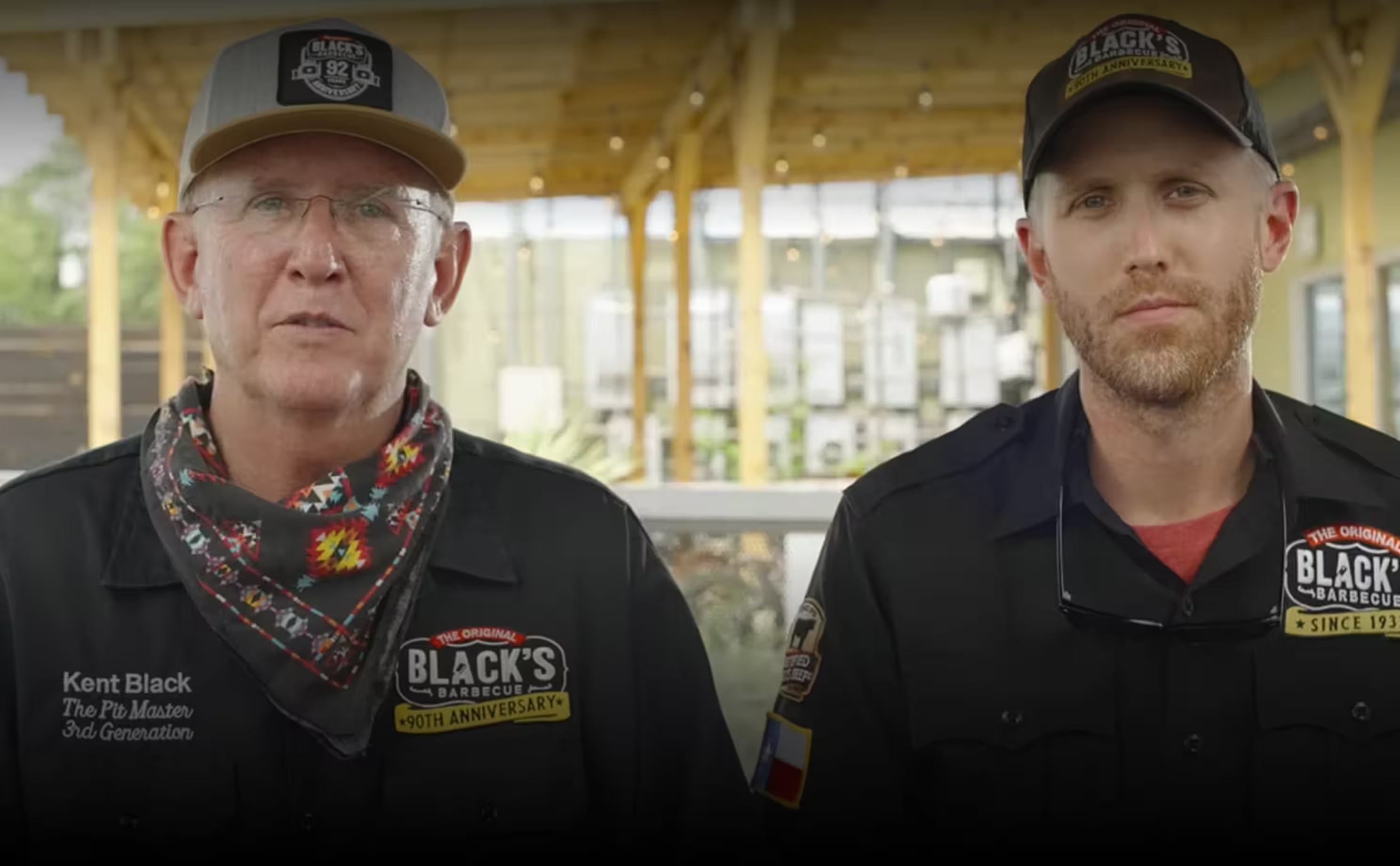
Thunderdome Restaurant Group moved 50-plus locations to a national chain–level contract and saved over $500,000 a year. Black's Barbecue cut food costs 7.5% with no supplier or ingredient change. Dish Society scaled from $10 million to $30 million in revenue while reducing food costs, including $60,000 a year on gloves alone. Full case studies here, or request a free food cost analysis, and we will tell you what your current arrangement is actually delivering.
FAQ
What is a GPO in foodservice?
A group purchasing organization that aggregates buying volume across many operators to access pre-negotiated pricing programs with manufacturers and distributors. GPOs are usually funded by administrative fees paid by participating manufacturers rather than by the operator.
Are foodservice GPOs worth it?
For single-unit operators buying mainly mainstream products, often yes. The pricing beats list and the cost to join is low. The limits appear with non-standard buying lists, brand commitments, and the absence of ongoing monitoring of your specific prices.
What is outsourced restaurant procurement?
Engaging an external team to manage purchasing on your behalf: renegotiating distributor agreements, benchmarking prices against the market, and monitoring for price drift. Fees are commonly tied to savings delivered.
Can I use a GPO and outsourced procurement together?
Often yes. They are not mutually exclusive, and being in a GPO is not evidence that your current pricing is competitive. That still has to be audited.
Can I negotiate with Sysco or US Foods on my own?
You can, but without knowing the distributor's cost base and the markup applied to your items you are negotiating without the central fact. That information asymmetry is the reason independents and national chains pay different prices for identical product.
Do I have to change distributors to lower food costs?
Usually not. Most of the savings available to independent operators come from renegotiating terms with the distributor they already use, not from switching.